


A large share of technical equipment — energy meters, inverters, drives, PLCs, measurement units — only speaks Modbus (RTU over RS485 or TCP/IP). But modern supervision systems and BMS expect BACnet. The result: a perfectly working Modbus device stays invisible to the BMS. The usual fix — a vendor-specific gateway or an intermediate PLC — is costly and rigid.
Modbus ⇄ BACnet gateway
Expose your Modbus equipment in a BACnet BMS — with no intermediate PLC and no proprietary hardware.
The problem
How the WBox does it
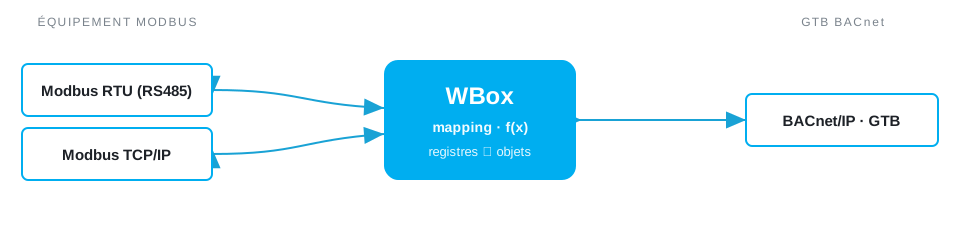
The WBox gateway reads Modbus registers (RTU over RS485 or TCP/IP, as master or slave) and exposes them as native BACnet/IP objects — analog input/value, binary input/value. The BMS discovers and reads them like any other BACnet device, with no awareness that the source is Modbus.
Mapping is done by drag & drop in the routing table, with an optional value transformation (scaling, unit change, type conversion) in Blockly or JavaScript. The bridge is bidirectional: the BMS can also write a BACnet setpoint that is pushed back into a Modbus register. A hysteresis and a consistency check limit traffic and protect the equipment.
What you need
- a WBox gateway (S103, S485, G110…);
- the Modbus driver;
- the BACnet driver.
Both drivers are licence-activated on the same gateway — no extra hardware. The same principle applies to other protocols: you can route KNX, M-Bus or MQTT to BACnet the same way, or the other way around.
© 2026 Weble GmbH. All rights reserved. Conditions générales