



A multiprotocol gateway is a device — often an edge box on a DIN rail — able to speak several protocols at once (KNX, Modbus, BACnet, M-Bus, MQTT, OPC UA…) and to route and transform data between them. It does more than translate: it routes, scales, aggregates and can run logic, all close to the field.
What is a multiprotocol gateway?
The component that makes devices speaking different languages talk to each other.
Definition
Why you need one
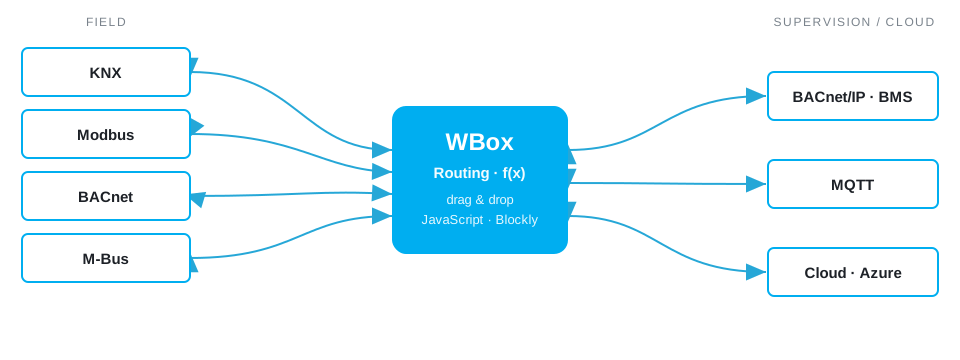
A modern building stacks heterogeneous technologies: KNX for lighting, Modbus for meters, BACnet for HVAC, MQTT for the cloud. Without a gateway, these are so many silos that do not communicate. A multiprotocol gateway removes those silos: a single platform links the field to supervision and the cloud — with no vendor lock-in.
Gateway, converter or PLC?
A converter translates one protocol to a single other, in a fixed way. A PLC runs logic but is not designed for interoperability or the cloud. A multiprotocol gateway combines all three roles: interconnecting many protocols, routing and transformation, supervision and cloud upload — at the edge, in the field.
The WBox, a multiprotocol gateway
The WBox is exactly that: an industrial IoT gateway that interconnects building and industrial protocols, performs inter-protocol routing by drag and drop, and pushes to the cloud. See concrete examples: Modbus ⇄ BACnet, KNX ⇄ BACnet, M-Bus metering.
© 2026 Weble Sàrl. All rights reserved. General conditions Product security